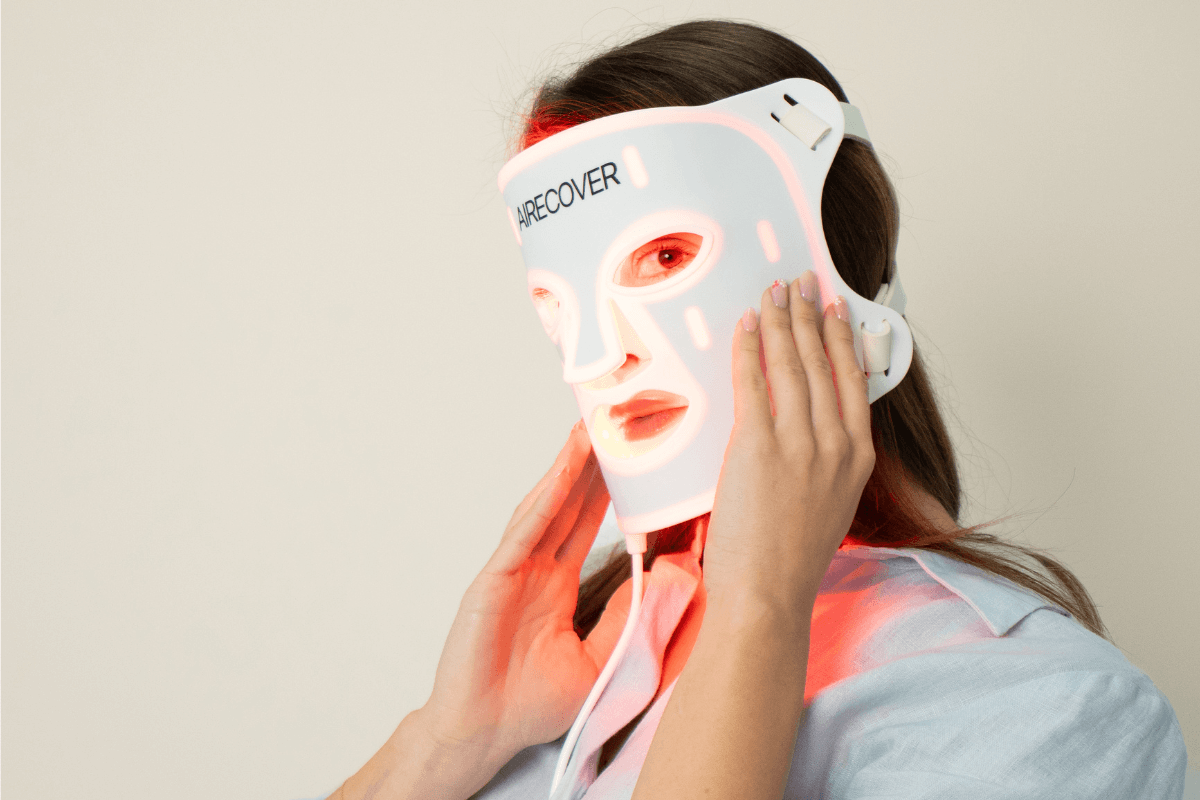

Red light and infrared light are increasingly used in photobiomodulation devices designed for skincare, wellness, and recovery. Although they often appear together in light therapy panels, they are not exactly the same.
The main difference lies in their wavelength and the way the light interacts with tissues. Red light is visible to the human eye and acts more superficially, while certain wavelengths of near-infrared light can reach deeper tissues.
That’s why many devices today combine both spectra in a single session.
What is red light therapy?
Red light therapy is a form of photobiomodulation, a technique that uses specific wavelengths of low-intensity light to generate biological responses in cells without producing the intense thermal effect associated with other types of radiation.
The red light used in photobiomodulation typically ranges from approximately 620 to 700 nm.
Among the most commonly used wavelengths are:
- 630 nm
- 660 nm
These wavelengths are visible and produce the characteristic red color of the devices.
Some research on photobiomodulation examines how these photons interact with cellular components related to mitochondrial activity and various cellular signaling pathways.
What is red light used for?
Because its optical action is relatively more superficial than that of near-infrared light, red light is used primarily in skin-related applications.
It is primarily studied for its relationship to processes associated with:
- collagen production;
- skin appearance and texture;
- radiance;
- expression lines;
- superficial tissue repair;
- inflammatory response.
Available research on LED therapy also indicates that red light can interact with deeper layers of the skin than other visible colors, while near-infrared light generally penetrates to a greater depth.
This explains why red light is commonly found in LED facial masks and panels designed for both the face and the body.
What is infrared light?
Infrared is part of the electromagnetic spectrum located beyond visible red light.
But there’s an important distinction here.
When we talk about red and infrared light therapy using photobiomodulation, we’re usually referring primarily to near-infrared (NIR)—not simply the infrared lamps used to produce heat.
Photobiomodulation frequently uses near-infrared wavelengths in conjunction with those of red light. The scientific literature generally places NIR within a broad range beginning at approximately 700 nm.
Common wavelengths used in photobiomodulation devices include:
- 810 nm
- 830 nm
- 850 nm
- 940 nm
Some multispectral devices also incorporate longer wavelengths.
What is near-infrared light used for?
One of the most interesting differences compared to red light is its ability to penetrate tissues to a relatively greater depth.
For this reason, near-infrared is being studied specifically for applications related to muscles, connective tissues, recovery, and other structures located beneath the skin’s surface layers.
This has made NIR a common feature in devices designed for:
- post-exercise recovery;
- muscle care;
- body wellness routines;
- deeper tissues;
- physical recovery.
However, actual penetration depth does not depend solely on wavelength. Other factors that influence it include the device’s power, irradiance, distance from the skin, exposure time, and the characteristics of the tissue itself.
Red Light vs. Infrared Light: Key Differences
| Characteristic | Red light | Near-infrared |
|---|---|---|
| Visible | Yes | Generally no |
| Typical wavelengths | 630–660 nm | 810–850 nm and others |
| Optical action | More superficial | Relatively deeper |
| Common uses | Skin and aesthetic care | Muscle and deeper tissues |
| Photobiomodulation | Yes | Yes |
| Can be combined | Yes | Yes |
It doesn't mean that one is better than the other.
They serve complementary functions.
Red light is particularly useful for treating more superficial areas, while near-infrared light allows for deeper penetration into structures located at greater depths.
Is red light or infrared light better?
It depends on the objective.
If the primary focus is on skin appearance, radiance, texture, or fine lines, red light typically plays a particularly important role.
When the goal is more related to muscles, physical recovery, or deeper tissues, near-infrared light becomes more important.
For this reason, rather than forcing a choice between red and infrared light, many modern panels incorporate multiple wavelengths simultaneously.
This makes it possible to target different depths and goals within the same session.
Why combine red and infrared light?
Combining both spectra allows you to take advantage of the characteristics of different wavelengths.
We can think of it simply:
Red light → skin and more superficial tissues.
Near-infrared → greater reach into deeper tissues.
The depth of penetration changes progressively with wavelength and tissue characteristics, so this explanation should be understood as a simplification and not as an exact boundary between the two spectra.
This is precisely why multispectral devices have become one of the most common configurations in at-home photobiomodulation.
What wavelengths do Airecover panels use?
Airecover’s Air Glow panels combine red light and near-infrared light within the same device.
For example, the Air Glow 500 red light panel incorporates seven wavelengths:
630, 660, 810, 850, 940, 980, and 1060 nm.
The first ones correspond to the visible red spectrum, while the rest operate within the near-infrared range.
This allows for the incorporation of different wavelengths within a single treatment routine, rather than using equipment that emits only red light or only infrared light.
The Air Glow line is specifically designed around this multispectral combination.
Does infrared light produce heat?
Not necessarily.
This is one of the most common misconceptions.
There are infrared therapies whose main objective is to generate heat, such as certain infrared lamps or saunas.
Near-infrared photobiomodulation works differently. LEDs or lasers of specific wavelengths are used to produce a photobiological response, not to intensely heat the tissue.
That is why we should not use the following terms interchangeably:
thermal infrared therapy and near-infrared photobiomodulation.
They are different technologies, even though both use parts of the infrared spectrum.
Can red and infrared light be used at the same time?
Yes. In fact, many photobiomodulation devices are designed specifically to combine both spectra.
Using multiple wavelengths ensures that the session isn’t limited solely to the skin’s surface or a single range of the spectrum.
Multispectral panels can be especially practical when you want to incorporate light therapy into a general skincare, wellness, and body recovery routine.
So, which one should you choose?
You don’t always have to choose.
The fundamental difference is simple:
Red light works primarily on more superficial areas and is particularly associated with skincare. Near-infrared light penetrates to a relatively greater depth and is frequently used in routines related to muscles and recovery.
That’s why combining both technologies can be particularly beneficial in devices designed for full-body use.
Airecover’s Air Glow red light therapy panels integrate different wavelengths of red and infrared light to tailor the therapy to different goals and areas of the body.
Frequently Asked Questions About Red and Infrared Light
What is the difference between red light and infrared light?
Red light belongs to the visible spectrum and typically uses wavelengths around 620–700 nm. Near-infrared light has longer wavelengths, is generally invisible to the human eye, and can penetrate relatively deeper into tissues.
Are red and infrared light the same thing?
No. They are part of different regions of the electromagnetic spectrum, although both can be used in photobiomodulation.
What is red light used for?
It is primarily used in applications related to the skin, aesthetic care, and certain cellular processes associated with photobiomodulation.
What is near-infrared light used for?
It is used especially when the goal is to reach deeper tissues, which is why it is frequently found in devices designed for physical well-being and muscle recovery.
What does NIR stand for?
NIR stands for Near Infrared. It is the type of infrared light commonly used alongside red light in photobiomodulation devices.
Is 660 nm or 850 nm better?
They do not serve exactly the same purpose. The 660 nm wavelength falls within the red light spectrum and is primarily used for relatively superficial areas. The 850 nm wavelength falls within the near-infrared spectrum and has greater penetration depth. That is why many devices combine both wavelengths.